
Starting an insurance agency typically costs anywhere from $5,000 to more than $100,000 depending on your business model, office setup, staffing plans, and technology investments. A lean, home-based independent agency can launch on a relatively small budget, while a full-service office with employees and aggressive marketing will require significantly more capital.
The good news is that new independent agents today have more flexible and affordable options than ever before. By keeping overhead low, choosing the right technology, and joining a no-fee agency network, many entrepreneurs can start building their book of business without taking on overwhelming upfront costs.

Key Takeaways:
- Starting an insurance agency typically costs between $5,000 and $100,000 depending on your business model, state, and overhead choices.
- The biggest startup expenses are licensing fees, E&O insurance, technology, office space, marketing, and carrier appointment costs.
- You can lower upfront costs by starting from a home office, choosing a lean tech stack, and joining a no-fee agency network.
- Smart Choice gives independent agents fast carrier access with no upfront fees, helping new agencies launch on a smaller budget.
Average Cost to Start an Insurance Agency
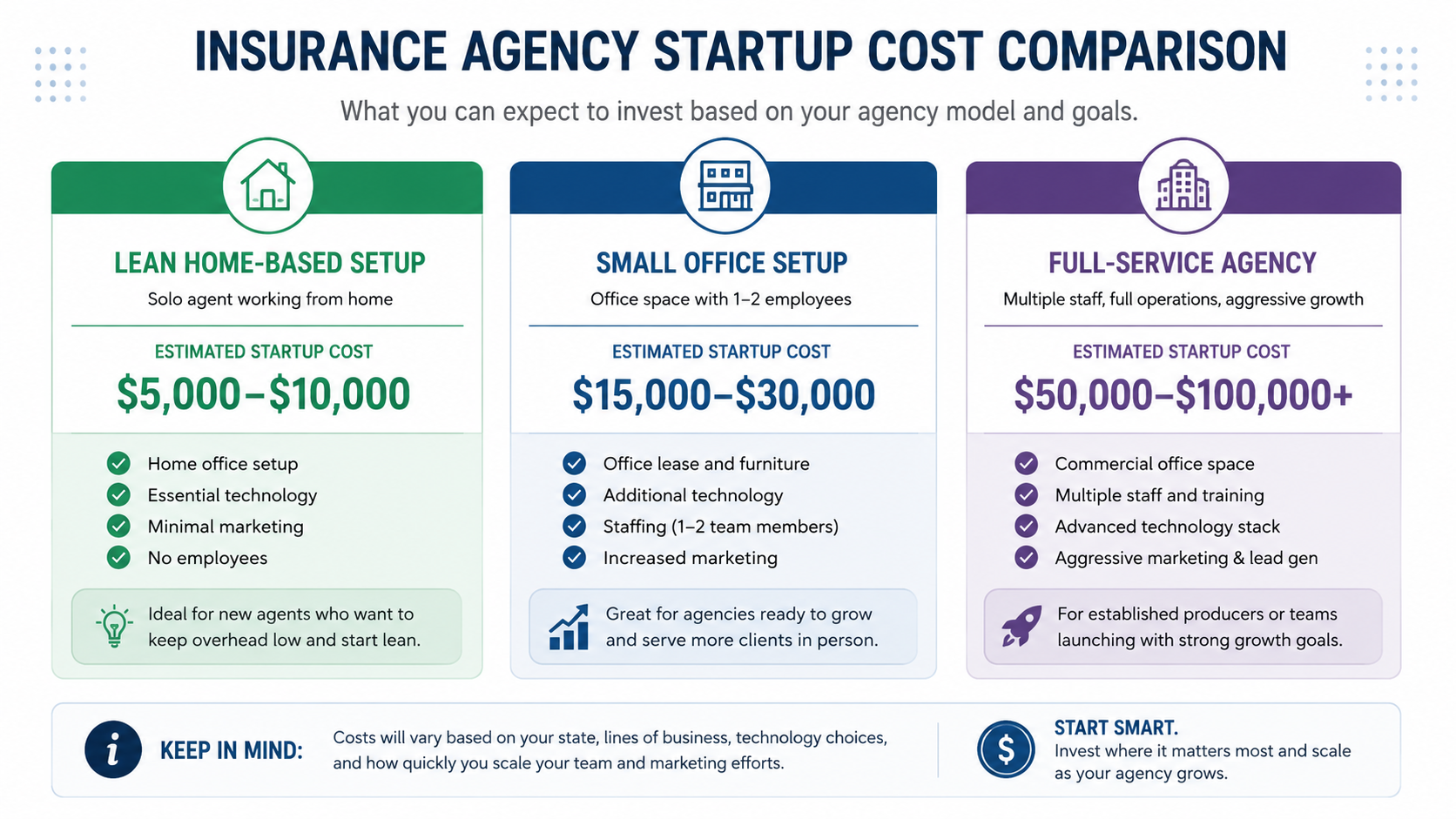
The cost to start an insurance agency can vary dramatically depending on the state where you operate, your business model, office setup, staffing plans, and growth goals. Some agencies launch lean from a home office, while others invest heavily in staff, office space, and paid marketing from day one.
Independent agencies generally have more flexibility and higher long-term income potential, but startup costs can vary widely. Captive agencies often have lower upfront technology costs because carriers provide systems and branding, while franchise models may require large franchise fees.
Learn more about building your business plan here:
Insurance Agency Business Plan Guide
You can also read more about launching your own insurance business here:
How to Start an Insurance Company
Licensing and Regulatory Fees
Pre-Licensing and State License Costs
Before writing a single policy, new agents must complete state licensing requirements. These typically include pre-licensing education courses, exam fees, fingerprinting, background checks, and the actual license application.
Most new agents should expect to spend between $300 and $1,500 per person depending on the state and number of licenses obtained.
- Pre-licensing courses: $150–$500
- State exam fees: $50–$150
- Fingerprinting and background checks: $50–$100
- License application fees: $100–$300
Agents planning to write business across multiple states should also budget for nonresident licenses, which can quickly increase total licensing costs.
Agency Registration and Surety Bonds
In addition to individual licensing, most agencies must register a legal business entity such as an LLC or corporation. Depending on the state, this may also include obtaining an agency license, filing a DBA, and securing a surety bond.
Combined agency-level registration and regulatory costs often range from $500 to $2,500 during the first year.
Learn more about insurance licensing requirements here:
Insurance Agent License Requirements
Errors and Omissions (E&O) Insurance
Errors and Omissions insurance protects agencies against claims related to professional mistakes, omissions, or negligence. Nearly every carrier requires independent agencies to carry E&O coverage before they can begin writing policies.
New agencies typically pay between $1,000 and $5,000 annually for E&O coverage.
Pricing depends on factors such as:
- Lines of business written
- Coverage limits selected
- Agency revenue
- Claims history
- Number of licensed producers
Agencies writing higher-risk commercial business or specialty lines may face significantly higher premiums.
Technology and Software Investments
Agency Management System and CRM
An Agency Management System (AMS) serves as the operational backbone of an insurance agency. It stores policy information, manages client communications, tracks renewals, and streamlines workflows.
Entry-level AMS platforms typically cost:
- Setup fees: $0–$2,000
- Monthly subscriptions: $60–$500+
Some agency networks provide discounted or bundled technology solutions, which can substantially lower startup costs for new agencies.
Comparative Raters, VoIP, and Website
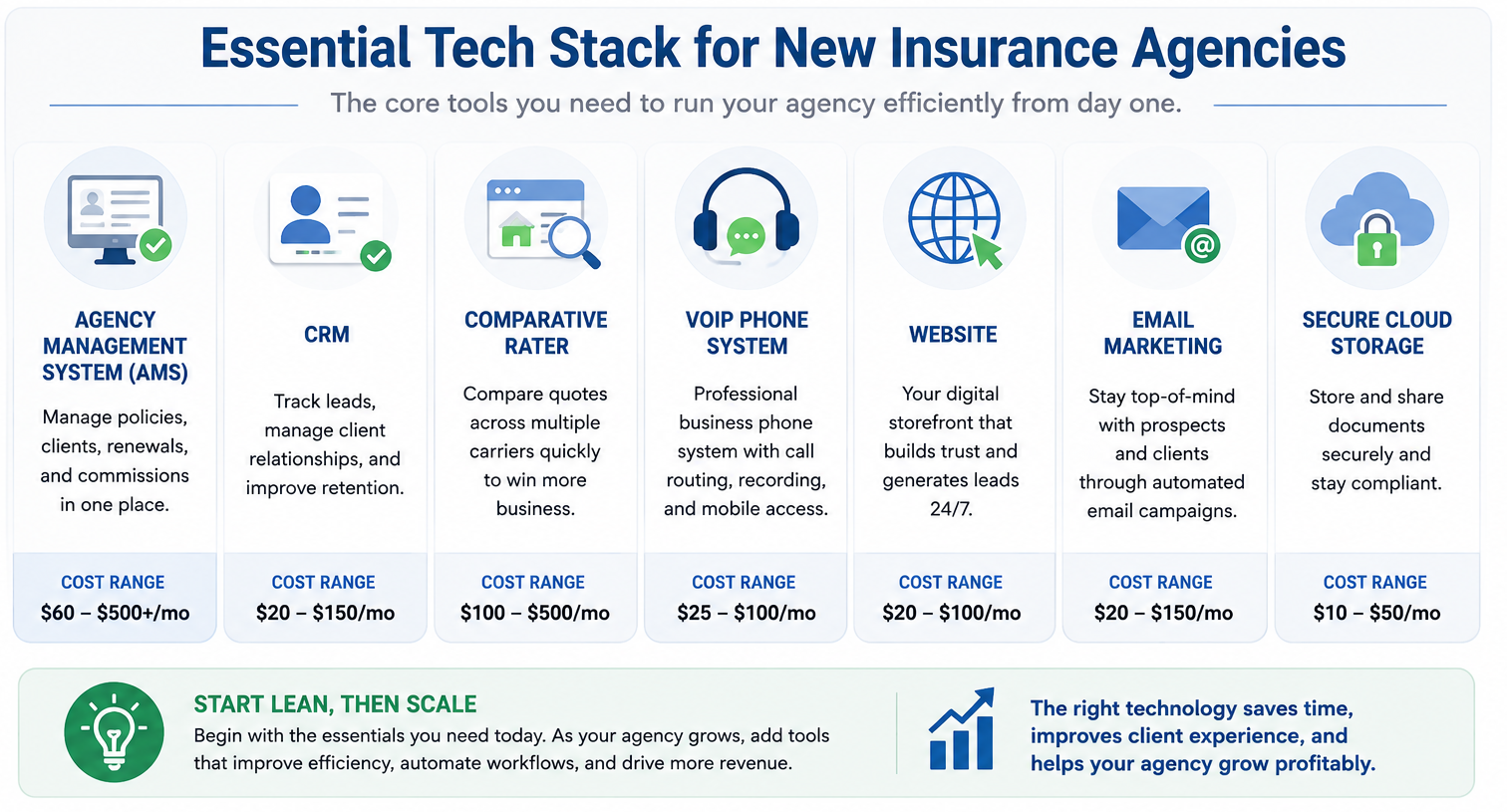
Most new agencies should also budget for comparative rating tools and secure cloud storage solutions, both of which help streamline operations, improve security, and support long-term scalability.
These recurring subscriptions can add up quickly, especially for agencies purchasing enterprise-level tools too early.
Avoiding Subscription Creep
One of the biggest mistakes new agencies make is overbuying technology before they truly need it. Many tools promise automation and scale, but they only make sense once the agency has consistent production volume.
New agencies should start lean and review their technology stack quarterly. Any software that is not directly improving efficiency or revenue should be reconsidered.
Office Space and Equipment
Office costs vary dramatically depending on your business model.
- Home office: Lowest-cost option
- Coworking space: Moderate flexibility with professional meeting space
- Commercial lease: Highest overhead but strongest physical presence
A home-based agency may spend less than $1,000 on equipment initially, while a leased office setup can easily exceed $20,000 before opening day.
Most new agencies only need:
- Computer or laptop
- Second monitor
- Printer/scanner
- Secure document storage
- Reliable internet connection
- Video conferencing tools
Agents who frequently meet clients in person may benefit from investing more heavily in office presentation and conference space.
Marketing and Lead Generation Costs
Branding and Website
Professional branding helps establish trust early. Most agencies should budget for:
- Logo design
- Website development
- Business cards
- Basic signage
- Google Business Profile setup
A lean but professional launch typically costs between $1,000 and $5,000.
Paid Leads, SEO, and Social
Marketing expenses vary significantly depending on strategy.
- Paid internet leads: $500–$5,000/month
- Local SEO: $300–$2,000/month
- Social media ads: $250–$2,500/month
- Email marketing: $20–$200/month
Referral marketing often delivers the lowest acquisition cost, while cold paid leads can become expensive very quickly.
Common Lead Generation Mistakes
Many new agencies overspend on lead vendors before refining their sales process. This often results in poor conversion rates and unnecessary cash flow pressure.
Instead, agencies should prioritize:
- Referral partnerships
- Community networking
- Online reviews
- Local SEO
- Cross-selling opportunities
These lower-cost strategies often outperform expensive paid lead programs over time.
Staffing and Hiring Expenses
Most agencies start with a solo owner/operator model, but growth eventually requires additional support.
Common early hires include:
- Licensed producers
- Customer service representatives
- Virtual assistants
- Administrative staff
Annual salary ranges may include:
- CSR: $35,000–$60,000
- Producer base salary: $40,000–$75,000 plus commission
- Virtual assistant: $10–$25/hour
Agencies must also account for payroll taxes, benefits, onboarding, and training costs.
Many newer agencies reduce fixed overhead by using 1099 producers or virtual support staff during the early growth phase.
Carrier Appointments and Network Fees
Securing direct carrier appointments can be one of the biggest obstacles for new independent agencies. Many carriers require:
- Production minimums
- Prior experience
- Established books of business
- Appointment fees
- Multiple years in business
This creates a major challenge for brand-new agencies trying to access competitive markets.
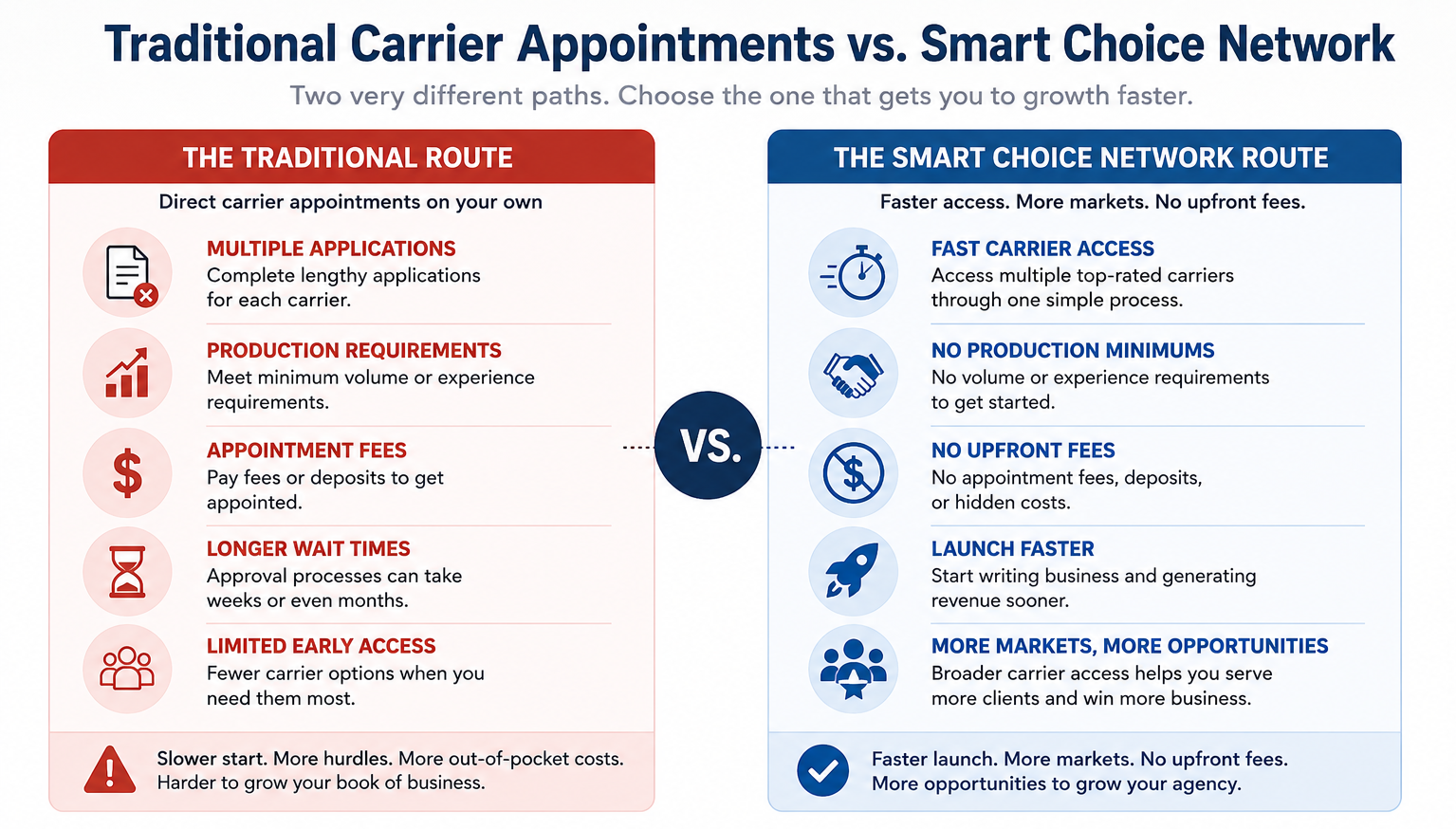
Agency networks provide a much faster path to carrier access. Instead of negotiating individual appointments, agents can leverage existing carrier relationships through the network.
"When I decided to go out on my own the hard part was getting carrier appointments. So, I looked into different aggregators and networks and for several of them, I would have had to pay a large down payment, with Smart Choice there were no fees. The bottom line is that our business has grown dramatically every year. I've hired three people and I wouldn't be here if it wasn't for Smart Choice. They really helped me."
— Letisia Aguirre, Capital Insurance Services of Florida
Smart Choice helps independent agents gain fast access to top-rated carriers without large upfront fees, making it easier for cost-conscious agencies to launch sooner.
Hidden and Ongoing Costs to Plan For
Many new agencies underestimate ongoing operating expenses.
Recurring costs may include:
- Continuing education credits
- License renewals
- Association memberships
- Bookkeeping services
- Tax preparation
- Legal review
- Cybersecurity tools
There is also a significant time investment involved in building a profitable book of business. Many agency owners spend unpaid hours on service work, retention, marketing, and administration before recurring commissions stabilize.
Sample Startup Budget for a New Insurance Agency
Lean Home-Based Setup
A lean solo agency operating from home may launch for approximately $5,000 to $10,000.
- Licensing and registration: $1,000
- E&O insurance: $1,500
- Technology: $2,000
- Marketing: $1,500
Mid-Range Small-Office Setup
An agency with a small office and one support staff member may require $15,000 to $30,000.
- Office lease and furniture
- Additional technology
- Staff payroll
- Expanded marketing
Full-Service Launch
A full-service agency with multiple employees, a commercial office, and aggressive lead generation can exceed $50,000 to $100,000+.
This level of investment only makes sense when the agency already has strong production pipelines or experienced producers joining the launch.
Tips to Reduce Insurance Agency Startup Costs
- Start from a home office during year one
- Use a lean technology stack
- Choose scalable month-to-month software
- Prioritize referral marketing
- Avoid unnecessary office overhead
- Join a network instead of chasing direct carrier appointments
These strategies can significantly reduce upfront risk while allowing the agency to scale over time.
Frequently Asked Questions About Insurance Agency Startup Costs
How Much Money Do You Actually Need to Start an Insurance Agency?
Most lean independent agencies can realistically launch with between $5,000 and $15,000. Agencies wanting office space, staff, and aggressive marketing should expect significantly higher startup costs.
Can You Start an Insurance Agency With No Experience?
Yes, but it is much easier with mentorship, training, and access to experienced partners. Many new agents join agency networks to bridge the experience and carrier access gap.
How Long Until a New Insurance Agency Becomes Profitable?
Many agencies take 12 to 24 months to achieve stable profitability. Growth speed depends heavily on lead generation, retention, cross-selling, and operational efficiency.
Launch Your Insurance Agency With Smart Choice
Starting an insurance agency requires careful budgeting across licensing, technology, E&O coverage, marketing, staffing, and carrier access. While startup costs vary widely, many independent agents can launch successfully without massive upfront investment.
Joining an established agency network can reduce startup barriers, improve carrier access, and help new agencies generate revenue faster. Smart Choice gives independent agents access to top-rated carriers with no upfront fees, helping agencies launch smarter and grow sooner.