
Key Takeaways
- An agency management system serves as the central operating platform for an independent insurance agency.
- Disconnected systems can create duplicate work, missed opportunities, inconsistent documentation and errors-and-omissions exposure.
- Startups should make an AMS part of their original business and technology plan, even when cash flow requires a phased implementation.
- Before selecting or upgrading a system, agencies should evaluate current tools, future needs, package tiers, implementation requirements and training.
An Agency Management System, or AMS, is the connected software platform that runs an independent insurance agency's daily operations — prospecting, quoting, binding, service, renewal, and retention — inside one fully-integrated system instead of a dozen disconnected tools. For most agencies, the question of whether to run with or without an AMS stopped being optional a while ago.
Insurance shoppers now compare more, and buy more online, than at any point on record. According to JD Power's 2026 U.S. Insurance Shopping Study, customers now receive an average of 3.5 quotes before buying, the highest level the study has recorded, and nearly half of new auto policies — 48%, up from 36% just five years ago — are now purchased digitally. JD Power's companion 2026 U.S. Insurance Digital Experience Study puts the figure for combined new auto and home purchases at 47%. Clients are not shopping less carefully because digital tools exist; they are shopping more, faster, and across more channels — inside a U.S. property-casualty market where insurer policyholders' surplus stood at $1.09 trillion as of mid-2025, according to NAIC's most recent industry analysis.
This demand for more, faster and multi-channel service drives agents’ need for a modern AMS that acts as core business infrastructure and delivers integrated workflows that fuel business productivity, rather than an optional administrative tool.
What Is An Agency Management System, And What Does It Actually Do?
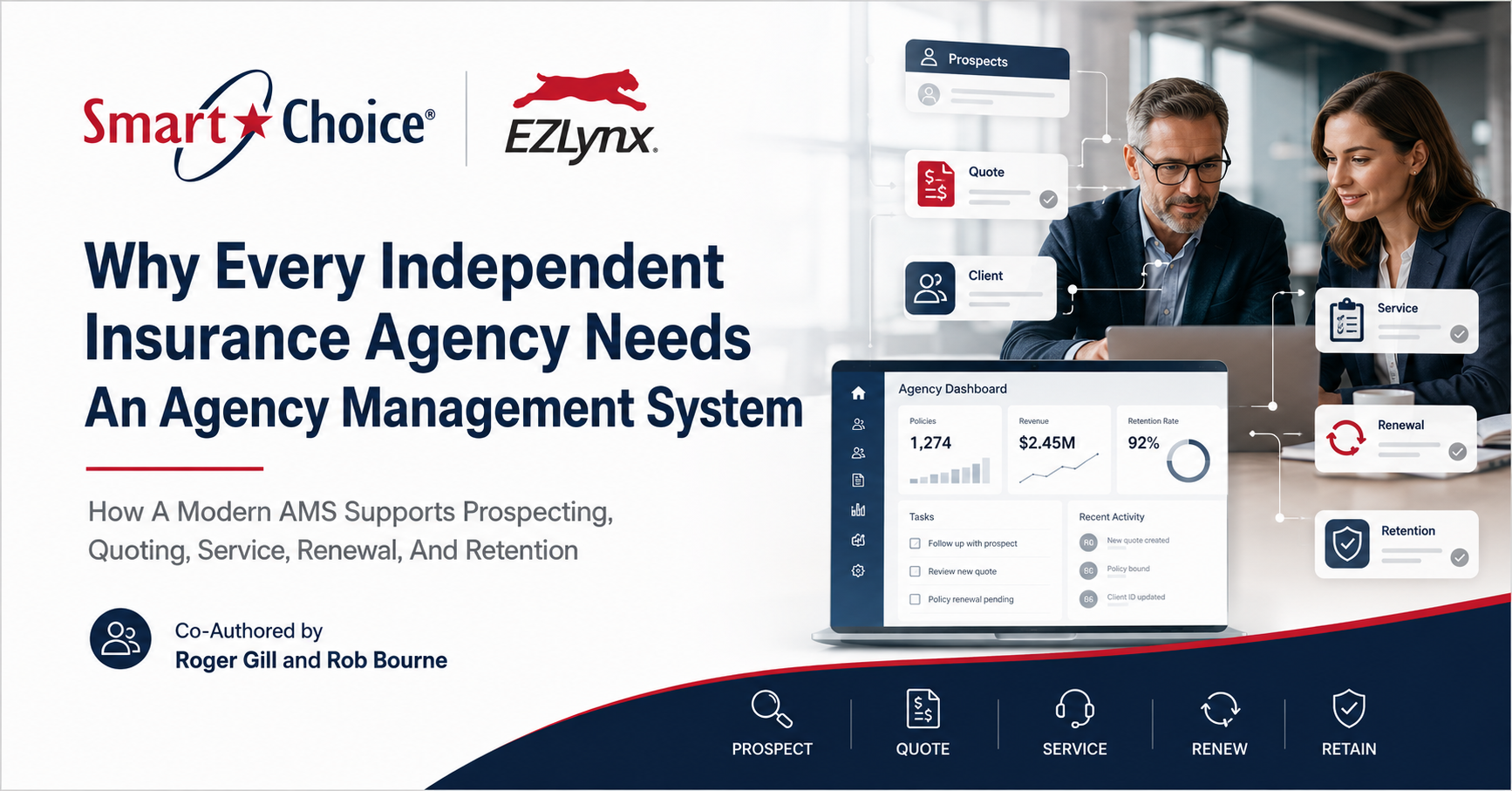
An AMS is the central operating platform for an agency's prospects, clients, policies, documents, communications, workflows, renewals, commissions, reporting, and service activity. A modern AMS may combine or integrate:
- Prospect and lead management
- Customer relationship management
- Personal and commercial lines quoting
- Policy and client records
- Email and text communications
- Document storage and electronic signatures
- ACORD forms and certificates of insurance
- Carrier downloads, billing, and claims information
- Task and workflow automation
- Renewal and retention management
- Commission accounting and production reporting
- Client self-service and, increasingly, artificial intelligence tools
The objective is not simply to store policy information. The objective is to have one connected operating system for the agency — and every major AMS vendor is now building toward that same goal of having a single solution suite.
What Happens When An Agency Doesn't Have One?
Many new and small agencies delay purchasing an AMS to control startup expenses. That's understandable; the bottom line matters. But without a structured system, agency information tends to scatter across carrier portals, email accounts, text messages, spreadsheets, paper notes, personal calendars, and separate marketing or e-signature applications.
That fragmentation may look manageable with a handful of clients; it becomes progressively harder to manage as the book grows.
The problem is not merely inconvenience; fragmentation produces missed opportunities and real errors-and-omissions exposure.
Fragmentation can produce missed follow-ups, lost prospects, slow quoting, duplicate data entry, inconsistent documentation, unanswered service requests, missed renewal opportunities, weak cross-selling, inaccurate commission records, and a growing dependence on the owner's memory instead of the agency's records.
This isn't a fringe complaint. The Big "I" Agents Council for Technology's 2026 Tech Trends Report found that managing too many disconnected systems ranks among independent agents' top-cited technology challenges, alongside simply keeping pace with the rate of change. Insurance Journal's 2026 Agency Technology and Growth Outlook research describes the same pattern as "distribution drag": small inefficiencies — duplicate data entry, fragmented quoting — that quietly compound as quote and service volume increases, until they limit how much an agency can grow without adding headcount.
When Should a Startup Agency Purchase An AMS?
A startup agency shouldn't ignore its cash-flow reality; licensing, insurance, and basic operating costs come first. But an AMS should be part of the original business and technology plan, not a distant future consideration.
Consider purchasing during initial setup when:
- Startup capital is adequate and meaningful early sales volume is expected.
- Multiple carriers or lines will be managed from day one.
- Automated lead nurturing is part of the growth plan.
- More than one person will need access to client information.
- The agency intends to scale quickly or is acquiring an existing book.
Set a near-term purchase target when cash flow is currently inadequate, the policy count is still very small, or other essential startup expenses have to come first, but attach a specific trigger to that target — a revenue level, a policy count, a first hire, or entry into commercial lines — rather than leaving it open-ended.
"Someday" is not an implementation plan.
What Should Independent Agents Do Next?
Technology will not fix a business that lacks a sound plan, adequate capital, the right licensing, carrier relationships, or sales discipline. It multiplies whatever is already there — good habits and bad ones alike.
Before purchasing or upgrading an AMS, review what the system's package tiers include. Then, inventory every separate tool the agency currently pays for that would be replaced by the new AMS, define what the agency needs to support over the next 12 to 36 months, and build an implementation and training plan before, not after, the purchase.
The decision is not whether technology matters. The decision is how quickly the agency can responsibly build the technology foundation it will need.
About the Authors: Roger Gill and Rob Bourne
Roger Gill is Virginia State Director for Smart Choice. He has spent more than 25 years as a producing agent and agent educator. Roger and his Smart Choice Virginia Team work with independent agents at every stage—from launch and transition to growth and long-term planning—providing hands-on development, market access, tech stack setup, real-world education and support.
Rob Bourne is the SVP and General Manager of EZLynx. He previously served as SVP at Applied Systems, overseeing Inside Sales, Account Management, Business Development, and Alliance Partnerships. Before that, he held senior roles at Athelas and Podium, where he spearheaded growth, revenue strategy, and operations. With an MBA from Cornell University and extensive experience in AI-driven platforms, Bourne brings strategic insight and proven expertise in scaling innovative technology solutions.
Build Your Agency on a Stronger Foundation
Smart Choice helps independent insurance agencies access the markets, resources, technology and support they need to build and grow their businesses.
Learn More About Smart Choice